
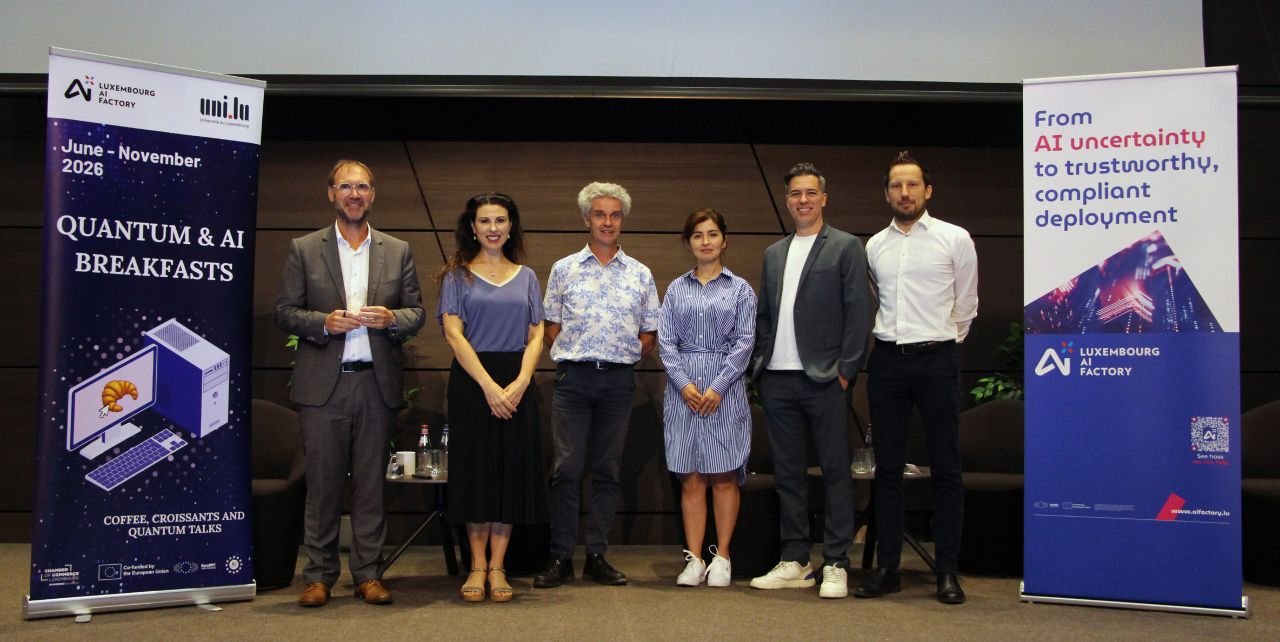
Quantum promises a new future. But can that future also be sustainable?
This question was at the heart of the second Quantum & AI Breakfast of 2026, organised by the University of Luxembourg together with the Luxembourg AI Factory, through the Green Economy Hub hosted at the Luxembourg Institute of Science and Technology (LIST), during the HPC Continuum Conference 2026.
LuxQuantum was pleased to contribute to the discussion, with our Co-Founder Samira Chaychi joining experts from academia and industry to explore how quantum technologies, artificial intelligence and high-performance computing can contribute to a more sustainable technological future.
Smarter systems, not simply more computing
One of the key messages from the discussion was that sustainability in computing is not only about reducing energy consumption. It is also about designing smarter systems that use resources more effectively.
From space robotics to satellite operations, emerging technologies such as AI and quantum computing could help create systems that operate more efficiently, last longer and reduce unnecessary resource consumption.
Quantum is different — not simply faster
Quantum computing is often described in terms of speed. But its potential goes beyond making existing computation faster.
Quantum represents a fundamentally different approach to solving certain types of problems. As AI continues to increase demand for computing resources, the future may not belong to one technology replacing another, but to architectures in which quantum, AI and classical high-performance computing work together.
As Jean Senellart of Quandela highlighted during the discussion:
“Quantum is not the solution by itself. The current solution is the combination.”
This hybrid perspective is particularly important as organisations begin thinking about the next generation of digital infrastructure.
Technology alone is not enough
Another important takeaway was that technological breakthroughs by themselves will not create a sustainable quantum future.
Progress will also depend on secure infrastructure, skilled people, collaboration between research and industry, and the ability to integrate new technologies with existing systems.
Fundamental research remains central to that process. As Jens Kreisel, Rector of the University of Luxembourg, emphasised during the event, fundamental science can open possibilities that we cannot yet anticipate.
Building the future through collaboration
At LuxQuantum, we believe the transition toward the quantum era will require collaboration across technologies, organisations and disciplines.
Quantum computing, AI and HPC will increasingly intersect. At the same time, the infrastructure supporting this transformation must be secure, adaptable and capable of evolving as technologies mature.
The future will therefore not be shaped by quantum alone.
It will be shaped by how quantum, AI, HPC and human creativity come together — and by how responsibly we build the infrastructure around them.